Latest Posts

Showing posts with label Worldcup. Show all posts
New Zealand made it two wins out of two in Pool A with a bizarre three-wicket victory against Scotland in Dunedin.
The Scots were reduced to 12-4 in the fifth over before Matt Machan (56) and Richie Berrington (50) put on 97.
Four batsmen fell first ball, a World Cup first, and only the third such instance in a one-day international, as they were 142 all out in the 37th over.
But New Zealand had more alarms than expected in a curious run chase, before winning with 25.1 overs to spare.
The Scots are in their third World Cup campaign and are yet to win a match in nine attempts, but came closer at the University Oval than anyone could have believed after such a destructive start.
They thrashed their higher ranked fellow qualifiers Ireland by 179 runs in a recent warm-up game yet it quickly became apparent they would not be emulating the Irish team's victory over West Indies on Monday.
Facing an in-form New Zealand on their own patch was a rather different proposition to a fragmented Windies, and the co-hosts, semi-finalists six times, justified their position as one of the leading contenders for the trophy with a fine display in the field after winning the toss.
Left-arm seamer Trent Boult expertly exploited the conditions, swinging the ball back into the right-handers at pace to claim wickets with his opening two deliveries in the second over.
Tim Southee also struck with consecutive deliveries and there was concern the lowest World Cup total of 36 by Canada was in jeopardy.
But Sussex left-hander Machan played with calm assurance in a 79-ball innings to restore some respectability with the purposeful Berrington.
However, wily spinner Daniel Vettori wrapped up the innings with successive wickets and the Kiwis had almost 40 minutes of batting before the official lunch interval.
Skipper Brendon McCullum and opening partner Martin Guptill appeared to want to reach the target in the nine overs bowled before the break, with number of wickets lost not affecting a team's overall run-rate in the group table, and both were caught behind in the mini-session.
The prolific Kane Williamson top-scored with 38 but edged seamer Josh Davey in the 18th over, one of four wickets to fall for 31 in a surprisingly ragged batting display from the Kiwis, who next face England in a day-night fixture in Wellington on Friday.
Scotland captain Preston Mommsen said he was "very proud" of his side after they ran the co-hosts so close


Once again India beat Pakistan in Worldcup this time man of the match Viratkholi . This is the first time india playing against pakistan in wc with out sachin. Our batting side is helprd by Kholi ,Raina, Dhawan and by bowling Shami helped us in a good way. Though pakistan skipper Mishbah tried a lot but he can't reach the score.
England suffered humiliation at the hands of Australia in their opening World Cup match. A crowd of 84,000 saw Aaron Finch, dropped second ball before he had scored, make 135 as Australia reached a formidable 342 for nine, the highest score England had ever conceded at a World Cup.
In reply Eoin Morgan’s side managed only 231 and lost by 111 runs, dismissed by the medium pace of Mitchell Marsh, who took five for 14 in one seven-over spell.
Only James Taylor saved some of England’s blushes, making an unbeaten 98 before the last man, Jimmy Anderson, was run out in confusing circumstances. Taylor had been given out lbw, but the stumps were then thrown down as well with Anderson out of his ground. Taylor was reprieved on review but Anderson given out instead.
The International Cricket Council later confirmed that he should not have been. A statement said: “The ball should have been deemed dead when the batsman (James Taylor) was given out leg before wicket (lbw). No further runs or dismissals were possible … the game ended incorrectly and an error was made.”
If it was a horror story for the England team, then it was doubly so for the captain. Morgan was dismissed for a six-ball duck, his fourth in five innings including one in his only warm-up game. However, Morgan, caught behind attempting to pull a short ball from Marsh, still insisted that he is frustrated rather than concerned. “I don’t feel too bad over that dismissal,” he said. “I toe-ended a pull and I think the ball stuck in the pitch a little. As a rule I am a huge nick-off candidate, I know that, and if that was how I was getting out, then I would be worried. But there is no pattern to it.”
Morgan defended the bowling tactics at the end of the innings that saw Australia score 105 runs in the last 10 overs. “We have different plans for different players,” he said. “It varies. It is certainly not easy at the end, and the ultimate is not just to restrict but to take wickets. We think the plans are sound but our execution has not been as good as it might be. We are looking for a higher standard of skill all round.”
Morgan praised Steven Finn following his five-wicket haul – which included a hat-trick – and Taylor, who had moved from three to six in order to accommodate Gary Ballance, and who added 92 for the seventh wicket with Chris Woakes, and went on to hit 11 fours and two sixes, one driven straight off the paceman Mitchell Starc.
“It was outstanding, especially in the circumstances,” said Morgan. “It was typical Taylor. He played himself in and then took advantage of that. We are looking for guys who can go on and post the sort of score that will win games. Here he batted closer to his natural position at five or six.”

Well, as close to the perfect game from New Zealand. They probably would have preferred one of their set batsmen to go on and notch a three figure score, but they’ll be satisfied that they start the World Cup with a professional performance.
Sri Lanka have issues, not least in the bowling department, where Malinga looks a pale shadow of his former self. Have Sri Lanka made an error in keeping him on this tour? He’ll no doubt bowl himself into form - there are more than enough games - but 10 overs, 0 for 84, is a huge worry.
Still, no need for total doom and gloom just yet. Thanks for joining me - I’m off to feel real again

Espn cricinfo have started a fantasy cricket league come lets play and win amazing gifts in it.         join a league there
league name ; The master batters
password : masterbatters
link :
http://games.espncricinfo.com/Fantasy/ManageTeam#_=_
Yuvraj ignored for World cup 2015, is this the end of  the road?: Yuvraj Singh the hero, the king of sixers, Yuvi Strong are all synonyms to this man in Indian cricket who played a major role for India to win the ICC cricket world cup 2011 and in the end was declared the Man Of the Tournament for his overwhelming performance both with the bat and the ball. It was him who gave the skipper Dhoni to maneuver  around with other bowlers and whenever he was handed over the ball responded with a wicket or two.
Yuvraj who fought cancer during and post the victorious world cup in 2011, made a successful comeback to the team, but was soon dropped due to lack of fitness and form and since then has not been able to make it back into the Indian cricket team.
Yuvraj last appeared for India in the ICC World T20 finals against Sri Lanka where poor batting form costed India crucial moments in the finals. But, since then he has tried his best to get fit and at the moment does look fit. He had a good opportunity in the Ranji season to showcase his form and he did that as well with 520 runs in the 3 matches that he has played for Punjab averaging well over 100.
News of Ravindra Jadeja who is currently unfit not making it in time for the world cup did rounds the last week thus prompting Yuvraj’s name back in the fray. Otherwise Yuvi has completely been off the radar of the BCCI and it was no surprise when he was dropped from the list of players contracted by the Indian cricket board annually.
Thus, it was a remote chance of him getting selected in the 15 despite of his mention not being there in the squad of 30. As a provision of the ICC allows such inclusion the probability was towards unachievable and so did happen. The selectors overlooked Yuvraj Singh for the 15 members squad for ICC cricket world cup 2015 and thus ending speculations.
Young left arm spinner and all-rounder Axar Patel has been picked along with Jadeja. Jadeja was a part of the 2011 team as well which makes Axar the guy to replace Yuvi. Axar shot to fame from illustrious performance for the KXIP and continued to impress in the ODI’s against Sri Lanka where he emerged as the leading wicket taker. A cool head with the bat gave him the all-rounders tag and in the last 6 months has done enough to make it to the World Cup 2015 squad. His age is the biggest asset as someone who is only 20 years will be in a much better position to perform than the 33 years old Yuvraj.
Though Yuvi himself had said earlier that it would not be the end of his world if not selected in the world cup team but, it will be really tough for someone who guided the team to victory in the previous championship to not find himself a part of the current lot.
But he has time and again shown the fighter that he is, if he can beat a life threatening cancer he can as well live with this adverse call. His priorities now should be to play Ranji cricket to full potential and make every attempt to prove that though not considered he continues to have the worth of being a part of the Indian cricket team again.
Pakistan stumbled in key matches in previous World Cups, but our perseverance and determination finally paid off in 1992, writes Javed Miandad
The ICC Cricket World Cup has over the years become ICC’s pinnacle tournament, an event which is eagerly-awaited by the fans and players alike. I was very lucky that my international career kicked off as a 17-year-old against the West Indies in Birmingham during the inaugural event in England. Twenty-one years later, curtains fell on it in the same mega event in Bengaluru. It had been a memorable journey all through these years.
 
I was lucky to feature in the first six ICC Cricket World Cups and when I look down the road, I think it was due to hard work and training along with the passion to perform which led me all the way. Being one of the two players to play in six ICC Cricket World Cups, is something to be proud of.
 
When the first edition was played back in 1975, limited overs cricket was in its very early days. The prime attraction for new players like me, and even for the experienced individuals, was to get a chance to mingle with fellow cricketers, assess oneself and try to know others better.
 
The ICC Cricket World Cup 1992 remains the most memorable one for me as we came from behind to win the tournament. I am delighted that I contributed to that success by finishing as the second leading run-getter behind New Zealand’s Martin Crowe.
 
Pakistan had consistently done well in the previous World Cups, but had stumbled in key matches. Had we not lost to the West Indies by one wicket in my debut match in 1975 after Deryck Murray and Andy Roberts put on 64 runs for the last wicket, we could have finished better. Ahead of this match, Pakistan captain Asif Iqbal had to be rushed to the hospital where he underwent appendicitis surgery and followed the proceedings from the hospital.
 
We again lost to the West Indies in the 1979 and 1983 editions, both times in the semi-finals. We should have won the 1979 semi-final after Zaheer Abbas and Majid Khan had set the stage for a perfect run-chase, but we failed to carry on the good work and collapsed like a house of cards.
 
The home event in 1987 ended in despair when we lost to Australia in the semi-final. We were clearly the best side in the tournament and produced some magical performances when the chips were down. Abdul Qadir’s performance with the bat against the West Indies in Lahore was a case in point. But I guess we ran out of luck when we needed it the most.
 
The semi-final didn’t start very well for us when Saleem Yousuf was injured in the 19th over and I had to keep wickets. Then Steve Waugh’s late cameo, which included 18 runs off the last over, lifted Australia to 267. In our turn, I was back on the crease in the 10thover, this time in batting gears. Imran Khan and I produced the best partnership of the match (112) but we found Craig McDermott too hot to handle and lost by 18 runs.

The loss was nothing less than a national tragedy. The mood in the country was somber and people were clearly heartbroken, an indication of what this sport meant to the passionate people of Pakistan. The semi-final was Imran’s last match for Pakistan, though the then President of the country convinced him to reverse his retirement decision and lead the team on the tour of the West Indies, which took place a few months later.
 
Our perseverance and determination finally paid off in 1992 when, after a shaky start, we won the last five matches on the trot to lift the trophy in front of 90,000 spectators at the MCG. Imran Khan played a master-stroke when he batted at number-three and who can forget Inzamam-ul-Haq’s cameo and then Wasim Akram’s consecutive deliveries – described as deliveries of the century – that dismissed Allan Lamb and Chris Lewis.
 
The victory had come after we had lost Waqar Younis before the start of the competition and had suffered defeats in three of the first five matches in a tournament.
 
It was a fairy-tale event for me. There was a big question mark on my participation due to a stomach infection and troubled back. I arrived just a couple of days before the tournament started and carried throughout the tournament. It was worth playing with pain as I contributed to the team’s cause by scoring five half-centuries, including in the semi-final and final.
 
The welcome we got upon our return as champions was unprecedented in the history of Pakistan. It was the holy month of Ramadan but the spectators thronged the Karachi airport and our team hotel, just to catch a glimpse of the players. The celebrations continued for days to follow.
 
The Bengaluru quarter-final in the 1996 tournament was my final international match and though I would have loved to finish on a high, we were fairly and squarely beaten on that day by a better India side.
 
During my World Cup journey, I got the chance to play with and against some of the very best cricketers. It will be unfair for me to give names but I would take this opportunity to thank everyone who supported, appreciated and backed me during my time at the ICC Cricket World Cup.
 
For me, it has been a privilege playing with them in the greatest cricket spectacle, memories of which will remain with me forever.
 
2015 © ICC Development (International) Limited


Former New Zealand captain says there is frustration of having only reached semi-finals, but side has punched its weight considering cricket isn't No. 1 sport in the country

EXCLUSIVE COLUMN FROM ICC PAGE:

If you have ever wondered whether it is possible to be frustrated by and yet satisfied with the same thing then, in my case, the answer is yes.
 
You might think the two emotions are contradictory but I reckon they sum up New Zealand’s quest for ICC Cricket World Cup glory perfectly, especially in my time as a player.
 
On the one hand there is the frustration of reaching semi-finals in 1999 and 2007 and yet never breaking through that glass ceiling to the final, or even going on to win the tournament.
 
But on the other hand is the knowledge we lost on each occasion to more skillful sides – in my case against Pakistan in 1999 and then Sri Lanka eight years later. And that, for a country where cricket is not the number-one sport and which, in terms of resources – both playing and financial – is well down the pecking order says we have punched well and truly above our weight.
 
That consistency of performance has actually been true of the Black Caps throughout ICC Cricket World Cup history as a record of six semi-finals shows, and it is something to be proud of.
 
However, it has also led me to wonder why it is we have not been able to go that extra mile and get into the final head-to-head contest for cricket’s greatest prize.


I cannot speak for other Black Caps line-ups down the years but in the case of the sides I led, I remember us feeling delighted we had made it
that far.
 
That is not to say we felt we had run our race as we still had the dream of greater glory. But I suspect the teams we came up against thought slightly differently, that the semi-final was just one more game towards the ultimate goal of lifting the Cup.
 
We tended to be more game-to-game in our approach and I think, in our heart of hearts, we hoped rather than expected to do well in those semi-finals.
 
Of course, that could have led to a more relaxed, pressure-off approach but still, I think there was the knowledge we were in an ICC Cricket World Cup semi-final and that created pressure, both individual and collective, all of its own.
 
As for the semi-finals themselves, it is possible now to be quite dispassionate about them and see very clearly where things went wrong. In 1999, against Pakistan at Old Trafford, we did not get enough runs against an outstanding bowling attack including Wasim Akram, Saqlain Mushtaq and Shoaib Akhtar. Four players, myself included, passed 30, but no-one reached 50. It left us needing early wickets in reply to try and rattle them but the ball did not swing for Geoff Allott, the tournament’s leading wicket-taker alongside Shane Warne, and Saeed Anwar and Wajahatullah Wasti added 194 for the first wicket to stamp all over us.
 
Eight years later, in what turned out to be my final One-Day International, we found ourselves on a pitch in Jamaica that felt more sub-continental than Caribbean, and with too many of us having off-days against a more skillful side in Sri Lanka, we were outplayed. It was frustrating but we could have no complaints.
 
Perhaps oddly, the tournament I feel most frustrated and a little bit empty about is 2003, in Southern Africa, when we did not make it to the last four.
 
It contained the best moment, personally, in my ICC Cricket World Cup career, as I scored an unbeaten 134 against South Africa in Johannesburg, including greats of the game in Allan Donald, Shaun Pollock, Makhaya Ntini and Jacques Kallis. It is a memory I will always treasure.
 
But thinking of that innings also reminds me that with the squad of players we had, including Shane Bond at his best, Chris Cairns, Daniel Vettori, Nathan Astle and youngsters like Jacob Oram and Brendon McCullum. We could have, and probably should have, gone further than the Super Sixes.
 
Instead, we folded against Australia on a poor pitch, wasting a brilliant six-wicket haul by Bond, did the same against India when a win would have taken us into the semi-finals and also gave up vital points to Kenya by opting not to travel there for security reasons.
 
I do not blame anyone for that latter situation. Most of the squad had been in Karachi the previous year when a bomb exploded outside our hotel on the morning of a Test match and New Zealand Cricket felt, quite rightly, that if there was any suggestion of a threat then the team would not be put in what had the potential to be harm’s way. But it cost us points and, in the final analysis, cost us that spot in the last four.
 
Can this crop of Black Caps go one better than any of its predecessors and make it through to the final or even win the tournament this time? I think they can.
 

This One-Day team is one of the most skilled New Zealand has produced and in Adam Milne, a bowler capable of bowling close to 100 miles per hour, they have an X-factor cricketer. The truth is, after all, you do not win ICC Cricket World Cups without wicket-takers, and he could be the missing piece in the jigsaw.

If they can get three of four players in red hot form during the tournament and gain early momentum then New Zealand could become an unstoppable force, much as they were for the majority of the event in 1992 when the country got right behind Martin Crowe and his side on their journey to – yes the semi-finals.
 
That tournament evokes great memories for me as I began watching it in Mumbai, on tour as part of a New Zealand under-19 side. We viewed the opening victory over Australia at Eden Park on a beaten-up old television in the middle of the night but it allowed me and every young cricketer in New Zealand to dream that one day it could be us enjoying the ride, playing for the country on the biggest stage of all and maybe, just maybe, going all the way to glory.
 
That will be the dream for this generation of New Zealand players now.

2015 © ICC Development (International) Limited


Sachin Tendulkar      @sachin_rt
One of the most decorated cricketers in the history of the game, Sachin Tendulkar played in six World Cups (1992-2011). He is the most successful batsman in ICC’s pinnacle event with 2,278 runs in 45 matches, including 482 runs in nine matches in India’s successful campaign in the ICC Cricket World Cup 2011. He is the leading run-getter in ODIs with 18,426 runs in 463matches.Tendulkar was the player of the ICC Cricket World Cup 2003 when India finished
runner-up to Australia.
 Sachin Tendulkar writes the first of his exclusive columns in his role as ICC Cricket World Cup 2015 Ambassador as he looks back over a stunning World Cup career that spanned over two decades and six     tournaments from 1992 to 2011.

On June 25, 1983, the Indian cricket team had won the ICC Cricket World Cup 1983 and images of the team holding the cup was an inspirational moment for the nation.
 
I was just 10-year-old and have fond memories of that victory. I also celebrated the victory till late in the night on that day with due permission from my parents. I was also inspired to take up playing the game with the season (hard) ball after the World Cup victory.
 
My first ‘live’ piece of World Cup action was during the 1987 edition, which was played in India. I was fortunate to be among the volunteers to be picked as a ball boy for the matches played in Mumbai. As I stood there watching the Indian greats on the field, I kept telling myself that I need to be a part of the action in the middle.
 
In 1992, I made my maiden appearance in an ICC Cricket World Cup match against England in Perth. This edition was different as it was the first time that coloured player clothing, white cricket balls and black sightscreens were introduced in ICC’s pinnacle event with a number of matches being played under floodlights.
 
I did not have an exceptional match, going wicketless in my 10 overs and scoring 35 runs, including sharing a 63-run stand with Ravi Shastri. We fell short of the target by nine runs.
 
India failed to qualify for the knock-out stage with the only consolation being in defeating Pakistan, the eventual champion in a match where I also received my first man of the match in ICC Cricket World Cup.   
 

The ICC Cricket World Cup 1996 was special as it was jointly hosted in India, Pakistan and Sri Lanka. My dismissal in the semi-final against Sri Lanka rankled me for a long time as it was the start of a batting collapse, which brought an end to the Indian campaign. 
I scored my first century in an ICC Cricket World Cup during this edition and also scored another one against Sri Lanka, the eventual champions, during the league stages.

The highs experienced during the league stages came crashing down and we were left to enjoy the brilliant batting of Aravinda de Silva and his partnership with Arjuna Ranatunga on the television set as Sri Lanka went on to win their first World Cup defeating Australia.
 
The ICC Cricket World Cup 1999 was a difficult tournament for me personally as I had to cope with the loss of my father in the midst of the tournament. It was very difficult as I tried to focus on the game in spite of my grief.  

The ICC Cricket World Cup 2003 was the closest I had come, till then, to lift the coveted trophy.
 
The entire team had been playing well and we were extremely charged up to take on Australia in the final. A little too charged up as we realised losing the final by a big margin! I had a memorable tournament scoring 673 runs in 11 matches – the most by any batsman in a single edition of the World Cup. The player of the tournament award I received was little consolation for ending up as the second best.
 
The most forgettable ICC Cricket World Cup for me has to be 2007 edition in the West Indies. The early exit from the tournament ranks among the worst moments of my cricketing career. We had a fantastic team but it was not to be! My pursuit to be a part of the World Cup winning team continued.
 
The disappointment in the tournament served as a boost to prove many ‘naysayers’wrong.
 
I remember in 2009, I spoke to the media about looking forward to the ICC Cricket World Cup 2011 and ‘being able to achieve what we want to achieve’. As the tournament progressed, we did worry our fans in the league stage with our performance but started getting our momentum as we entered the quarter-finals.
 
Beating top sides like Australia, Pakistan and eventually overcoming Sri Lanka in the final, India emerged as the first nation to win the ICC Cricket World Cup on its home soil. It was even more special as I had finally been part of the World Cup winning team after 22 years of pursuit. 


The victory in 2011 was the highest point of my career as a nation unified in its celebrations. 

The Indian team’s preparation to defend the title in the ICC Cricket World Cup 2015 began some time ago and I look forward to returning to the World Cup as an ICC Ambassador.
2014 © ICC Development (International) Limited
First-person articles to be available on a daily basis from 31 December and can be downloaded for free editorial use from the Online Media Zone


The International Cricket Council (ICC) today unveiled its team of distinguished cricketers who will contribute expert columns in the lead up to and during the ICC’s pinnacle event, the ICC Cricket World Cup 2015, which begins in Australia and New Zealand on 14 February.
 
The first-person columns will be available from the Online Media Zone on a daily basis from Wednesday, 31 December and media can download these for free editorial use, but must credit the ICC by adding 2014 © ICC Development (International) Limited at the bottom of each article.
 
ICC’s expert columnists include Aminul Islam (Bangladesh), Andy Bichel (Australia), Alistair Campbell (Zimbabwe), Paul Collingwood (England), Stephen Fleming (New Zealand), Trent Johnston (Ireland), Javed Miandad (Pakistan), Muttiah Muralidaran (Sri Lanka), Sir Vivian Richards (West Indies), Graeme Smith (South Africa) and Javagal Srinath (India).
 
In addition to these stalwarts, India’s Sachin Tendulkar and Balwinder Singh Sandhu, Allan Border of Australia, West Indies’ Courtney Walsh and Pakistan’s Inzamam-ul-Haq will also contribute exclusive articles for the ICC.
 
This initiative is a further enhancement of the ICC’s ongoing service to cricket fans and global media as these celebrated cricketers will share their insight, knowledge and experience through the Online Media Zone.
 
In the lead up to the tournament, the columnists will discuss a wide range of topics, including reflecting on their time at ICC Cricket World Cups, assessing their respective sides, talking about their highs and lows, discussing how One-Day International cricket has evolved over the years, looking back at some of the best cricketers to have played this exciting format, and looking forward to the players to watch out for during the tournament.
 
Once the event kicks off, the guest writers will preview and analyse matches as the world’s 14 best sides go head to head for the ultimate prize in the sport in the 44-day tournament during which 49 matches will be played.
 
Sachin Tendulkar’s column From ball boy to World Cup winner will be the first of a series of first-person articles, which will be released on Wednesday, 31 December at 1000 (Dubai time). This article will be followed by pieces by Stephen Fleming, Javed Miandad and Sir Vivian Richards.
 
Besides releasing exclusive print content, the ICC will also distribute video interviews of Grant Flower (Zimbabwe), Richard Illingworth (England), Anil Kumble and Javagal Srinath (both India), Clive Lloyd (West Indies), Adam Gilchrist and Geoff Marsh (both Australia), and Waqar Younis (Pakistan).
 
Furthermore, an exclusive video interview with ICC Chief Executive David Richardson, who represented South Africa in the ICC Cricket World Cup 1992 and was ICC’s General Manager – Cricket at the previous three events, will be released on 13 January, a day before the world celebrates one-month to go to the start of the tournament.
 
This and other video interviews will be available on the Online Media Zone and can be downloaded for free editorial use. When using these video clips, TV news channels will be requested to credit the International Cricket Council and are reminded that the content can be used for editorial purposes only for a period of 14 days from the date of first release by the ICC.
 
Commenting on the initiative, ICC Chief Executive David Richardson said: “The involvement of these highly respected cricketers in the ICC Cricket World Cup 2015 in a journalistic role is an exciting initiative. I am sure this enhancement will a broader and better perspective of the game, and at the same time will take the coverage and promotion of ICC’s pinnacle event to a new next level.”
https://ssl.gstatic.com/ui/v1/icons/mail/images/cleardot.gif
 
Collingwood, who is England’s leading run-getter in ODIs and captained his country’s 50-over side from 2007 to 2009, said: “I am delighted to be working as a guest writer for the ICC for the ICC Cricket World Cup 2015. It will surely be an exciting event and I look forward to sharing my opinions with you in the weeks ahead.”
 
Miandad, who won the ICC Cricket World Cup 1992 with Pakistan, said: “On the occasion of the ICC Cricket World Cup 2015, some of the most experienced and knowledgeable cricketers will be writing columns from a historic perspective. I am proud to be part of this privileged panel.”
 
Muralidaran, who was a member of the Sri Lanka side that won the ICC Cricket World Cup 1996 and is the leading wicket-taker in ODIs, said: “I am pleased that the ICC has offered me the opportunity to share my knowledge and understanding of the game with our passionate cricket fans through columns.
 
“The ICC Cricket World Cup is the biggest event and it is a privilege to be part of it in any capacity. Like all my other knowledgeable colleagues, I look forward to this exciting experience and playing my role in promoting this wonderful event.”
 
The schedule of exclusive content (to be released at 1000 Dubai time) is as follows: (subject to changes):

 
Wednesday, 31 December – First-person article by Sachin Tendulkar
Thursday, 1 January – First-person article by Stephen Fleming
Friday, 2 January – First-person article by Javed Miandad
Saturday, 3 January – First-person article by Sir Vivian Richards
Sunday, 4 January – TV interview with Clive Lloyd
Sunday, 4 January – First-person article by Paul Collingwood
Monday, 5 January – First-person article by Balwinder Singh Sandhu
Tuesday, 6 January – First-person article by Allan Border
Wednesday, 7 January – First-person article by Inzamam-ul-Haq
 
Schedule of exclusive content from Thursday, 8 January to Thursday, 15 January will be announced on Tuesday, 6 January 2015


From 2007-2014 srinlanka enters all final in International cricket world cups both in 50overs and T2o format(2times 50over ,2times t20)and finally they had victory.


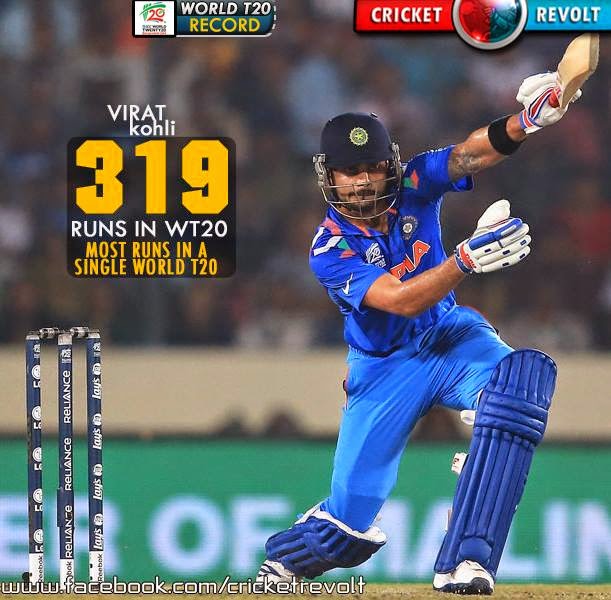
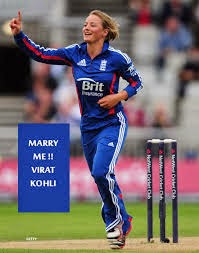
Kholi is the highest run scorer of the tournament. He scored 391 runs in 6matches 5fifties in it. He also get a marraiage proposal (Danielle Wyatt sent our proposal on Twitter –‘kholi marry me’—following his impressive batting display againsy SouthAfrica.)


Netherlands Made History
Chase 190 Target in Just 13.5 Ovs
Now Netherlands in Super 10..
A DUTCH HEIST: Stunning from Netherlands. They pull off the quickest chase of a target of 190 or more and qualify for the Super 10s knocking out Ireland and Zimbabwe. A total of 30 sixes in the match- the highest in T20Is. Netherlands hit 19 of them - again a record for the highest sixes by a team in T20Is. Beware England and Co.